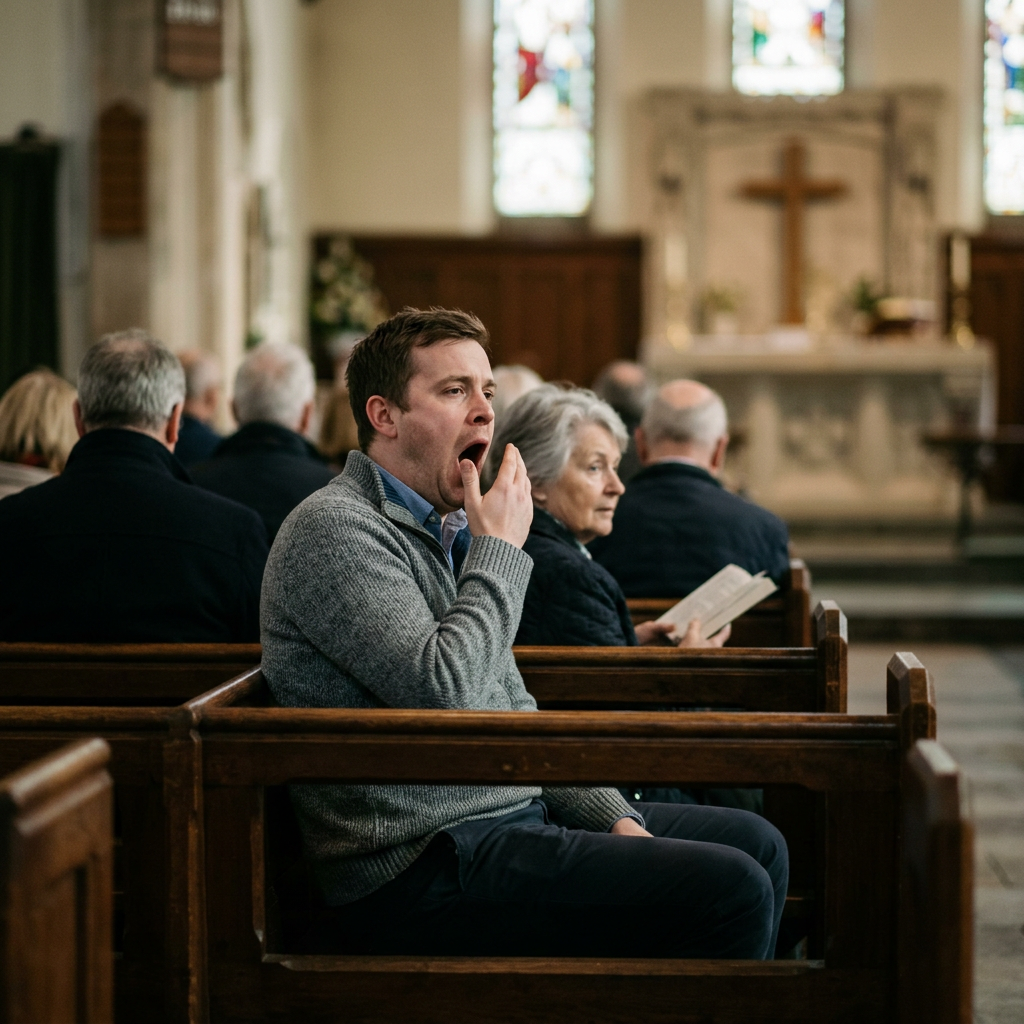
One rule of thumb regarding how long a sermon should be is that you can preach for as long as you can hold their attention. Which in my case is typically 35-55 minutes, with an average of about 45. I do cheat a little because in our liturgy, the sermon text is read prior to the sermon proper, which allows me a few extra minutes. While a 45-50 minute sermon is a bit taxing on the youngest and oldest in the congregation, I can generally tell that there is good engagement. But yesterday, somewhere around halfway through my text, the congregation was beginning to struggle.
We are in 1 Corinthians and since I am the kind of preacher that gets bogged down in texts, I had determined that we would move the epistle at a brisk pace. Having finished up chapters 5-6 regarding the discipline of members involved in fornication along with the teaching on the Christian sexual ethic, we were approaching other related topics of sex, marriage, divorce, etc… which breaks down in rather encyclopedia like fashion into the outline below.
- Celibacy and marriage (vs 1-6)
- Marriage and single-ness as gifts (vs 7-9)
- Divorce (10-11)
- Mixed Marriages (12-16)
- The rule of “abiding in your calling” (17-24)
- The Unmarried (25-35)
- Daughters and sons (36-38)
- Widows and widowers (39-40)
The question before me was whether to break this up into 2 weeks or try to tackle it all at once, and I decided that while there were some interesting universal principles and exegetical questions, the best option would be to just approach it with straightforward application and move through the eight divisions with a quick commentary. It isn’t my normal homiletical approach, but it seemed to suit the text.
By the time we got to “abiding in your calling”, the congregation seemed somewhat taxed (but willing, I should add). The sheer number of points is quite high, and the lack of illustrations (not a lot of time for these) didn’t provide moments of mental reset. I briefly considered stopping and picking it back up next week, but decided to push through. Was I right to do so?
The term “boring sermon” lacks specificity. To a lost person almost any sermon is boring. To a child almost any sermon is long. But as the preacher, I use the adjective simply as a recognition that this sermon was harder to listen to and process that other sermons. : I don’t regret this. In fact, I think every preacher should preach a sermon like this from time. Every preacher should preach a “boring” sermon.
In much of modern Christianity, the idea that a sermon would be boring is anathema. I believe one megachurch pastor even criticized expositional preaching on the basis of it being “lazy”. For seeker sensitive churches and churches that judge themselves almost exclusively on attendance, a boring sermon is a big fat failure. If they are bored, then they won’t come back. Spurgeon once said that no preacher had the right to bore his audience, but I think what he meant by that and what modern folks might mean by that are different. No preacher has the right to preach an unnecessarily long sermon. No preacher has the right to preach a structurally confusing sermon. No preacher has the right to preach a sermon with an attitude of apathy. I say “amen” to all of this. But no preacher has the right to ignore the text in order to preach a more “interesting” sermon.
Several years ago I listened to a sermon at the opening ceremony of a Christian college. The preacher was engaging and had a sermon text. His exegesis was a bit wonky, but there was some cohesion and consistent application that seemed to be going to the idea that just because you are a Bible college, it doesn’t mean you actually know Jesus. There were a couple of points that fit the text, but then he got to point #3 and just went completely away from the text. To say there was a tenuous connection would have been a tenuous statement. But then he got to his illustration and I realized why: his entire sermon was really building up to this one illustration of this great thing his church had done/experienced. What he really cared about was that everyone hear this great story. And all the kids went wild and clapped and cheered and he got what he wanted. But, in my estimation, he had intentionally abandoned the text and thus done a disservice to the students.
I don’t regret preaching a “boring” sermon from time to time because I think there are other considerations than if the audience finds it interesting or entertaining. If one rule of thumb for how long to preach is “however long you can hold their attention” then another rule of thumb might be “however long it takes to explain and apply the text”. Because for the exegetical preacher, the text is what forms people. If the people form the text, then the Word of God has lost its place of primacy within the gathering on the Church. The Church gathers in order to be formed into the body of Christ by water, wine and wafer, and Word.
I made a judgment call regarding how much text I would preach, but that still requires me to explain it and apply it sufficiently to the gathered church. Especially in a text like 1 Corinthians 7 that literally describes every martial situation a congregant might find themselves in. And that simply necessitated a longer amount of time in a text that is formatted somewhat encyclopedically.
Was this a mistake? Well, that is certainly possible. In retrospect, I am tempted to say that there are definitely two weeks’ worth of material to address. Could I have found a more engaging way of formatting the sermon? Always yes to this question. Someone is out there preaching 1 Corinthians 7 in a more interesting way than I did. Am I beating myself up? Only as much as I ever do. I always think I could have preached a sermon better. Found a more helpful approach. Made better application. Explained with greater clarity. But the mere fact that the sermon was hard (boring, if you will) doesn’t compound the normal self-reflection of Monday morning.
It is good for the congregation, from time to time, to encounter a “boring” sermon that forces them to engage dormant mental faculties and intentional focus. Some sermons should be a little out of reach. Preachers are not entertainers. It is also good for a congregation to leave the church focused less on how they feel and more on what they learned. I am concerned that far too many Christians prefer an emotional experience to an edifying assembly. And it is good for the pastor. It builds character to know that a better sermon was possible. It builds character to look at your congregation’s fading and engagement and determine to push on. If the work of God is thwarted by one gathering that is less than exciting, it probably isn’t a work of God.
None of this is an excuse for poor preaching. My failures are my failures and I need to learn from them. But a “boring” sermon is not, in and of itself, a failure. Not every sermon needs to challenge the intellect and patience of the congregation, but some texts will demand it. Not every text is formatted as bullet points of application, but some are. Don’t shy away from these texts. You are not building an audience; you are edifying the people of God. Something is spiritually wrong with pastors who are more concerned about whether or not the crowds are going to gather than they are that God’s people are equipped by God’s Word to live a holy life.
As I descended from the platform, I fully expected the congregation to flee the sanctuary at the first opportunity. Surely, I thought, they had endured as much as they could. But they didn’t. As I chatted in the sanctuary with various people, I could hear the hum of conversations in the Fellowship Hall. As I loaded up my clan in the minivan, several stayed behind to share a meal and a follow up Bible study. And I felt the glorious relief of knowing that Christ is building His church, even when I preach a boring sermon.


