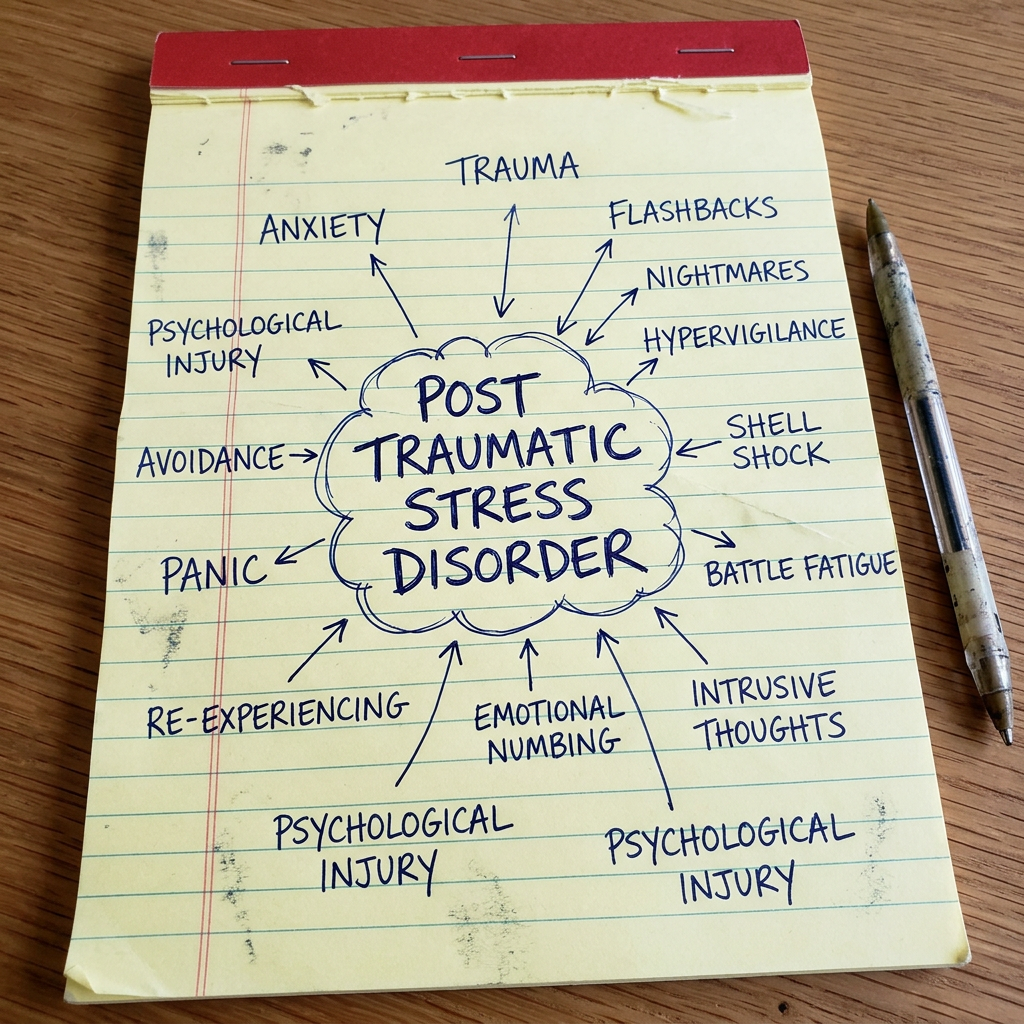
Several years ago we were sitting down with a missionary couple with whom we are close. We knew that they had been through some struggles and were receiving counseling, but I was somewhat surprised to learn that the counselor had issued a PTSD diagnosis. Post traumatic stress disorder is a clinical description of a phenomenon noted since ancient times of the response soldiers might have to warfare, including insomnia, nightmares, and emotional detachment. In World War 1, it was called shell shock, which while far less clinical sounding, is certainly more evocative. Other terms such as “combat stress” or “battle fatigue” described a similar phenomenon. In 1952, the American Psychiatric Association’s first Diagnostic and Statistical Manual of Mental Disorders (DSM Version 1) introduced a category for this, but it wasn’t until the revised DSMV III in 1980 that the term Post Traumatic Stress Disorder made its way into the lexicon. In DSMV- V (2013), it was relocated from an anxiety disorder to its own category.
I am somewhat of an agnostic about how the term is getting deployed in the world today. In a culture where victimization is social currency, “trauma” has become hackneyed and fails to capture the fulness of the human experience when suffering is endured. By which I mean that as a physical term, trauma is a great description for what happens to material stuff when it comes into violent contact with other material stuff. But when it comes to the human soul, “trauma” fails to capture the agency of moral beings, or the spiritual capacities of individuals, or the depths to which belief systems and rational thoughts make such suffering alternately bearable or unbearable.
So while I reject the wholesale attempt to describe the soul-ish life of the sons of Adam and daughters of Eve in medical terms, it would be obtuse to dismiss the obvious impact that warfare has on soldiers as pure psychobabble. Experiences that overwhelm the senses and are associated with violent human suffering understandably leave deep marks upon the soul. What psychologists are trying to capture with that very clinical term “post traumatic stress disorder” is a kind of baptism into suffering. In fact, Jesus himself anticipates His passion in this way:
“But I have a baptism to be baptized with; and how am I straitened till it be accomplished!” (Luke 12:50)
“Baptism” captures the suffering of the crucifixion well, doesn’t it? Baptism is an immersive experience. To be baptized is to be plunged into the waters, just as Jesus understands His coming ordeal to be a time of immersive suffering in which He would be plunged into the chaos of human hatred and physical torment. The waters of suffering close in upon the individual and no part of him escapes contact with it. Everywhere he looks there is suffering. Everything he touches becomes a part of the experience. Suffering envelopes the individual like the waters of baptism.
Baptism also fits this type of suffering because to be baptized into something is a sign of identifying with that thing (as Christian baptism identifies an individual with Christ and His church). The soldier who experiences such things struggles to fully leave those events in the past because they become a part of him. The sufferer becomes marked with the suffering, although the marking is not always physical. Waking insomnia and sleeping nightmares may be the mark for some. Anxiety in enclosed spaces and physical tics may be the mark for others. Emotional distance and difficulty connecting with loved ones may be what marks another. Whatever the manifestation, the individual will be identified with the suffering just as the nail scars on Christ’s hands remain as a mark of His suffering.
As makers of meaning, we are compelled to find meaning in suffering. Every family fighting for a loved one at a hospital is trying to find some meaning in it. Every parent fighting for their wayward child is trying to find a greater good that can come of it. If we could tell a story large enough to capture the suffering, at least the suffering would have a context. But for many people diagnosed with PTSD, the magnitude of the suffering itself seems larger than any story one could tell that would make sense of it. Perhaps this explains why certain theatres of war leave deeper marks upon the individual. There is a different narrative surrounding World War II than there is around the Vietnam War. There is a different kind of experience in lining shoulder to shoulder with your comrades and facing another army lined shoulder to shoulder than there is in the house-by-house combat of Fallujah, where the enemy may be a child. The violence of war may be contextualized (to some extent) by being the “good guys”, vs. the futility of war may be amplified by being the “bad guy”.
Finally, it is noteworthy that suffering of this magnitude is greater than the individual, just as the waters of baptism are greater than the one plunged into them. Suffering that consumes the individual, like the kind that made our Lord cry out, “My God, my God, why have you forsaken me?” dwarfs the individual. The individual feels lost within the vastness of such suffering and is unable to find meaningful points of navigation to process and move through the experience.
And while it is comforting in and of itself to remember that our Lord suffered in such a way, there is actually better news than that for those who have been baptized into this kind of suffering, and that better news is that the sufferer can himself be baptized into Christ. And to be baptized into Christ is to be baptized into the redemption that came through suffering. While we might struggle to find meaning in every bit of suffering that has happened in human history, we can definitively say that the suffering of Christ was neither random, futile, or meaningless. It was intentional. It was redemptive. It is effective.
Jesus’ suffering entailed all the chaos of calamity and tragedy. He truly was an innocent man, dying for crimes which he did not commit. He was abandoned and forsaken, misunderstood, betrayed, and denied by his friends. The crucifixion was violent and torturous to the body. But it was not meaningless.
The good news for those afflicted with the distress that comes from experiencing overwhelming violence and suffering is that in Christian baptism, you are no longer identified with tragedy that is meaningless, but with tragedy that is redemptive. The violence that marks your soul is purged of its pain as it is immersed into the greater suffering of Christ. The torment of your strife is tempered as it takes on the hope of new life. Your story does not end in nihilism, but in resurrection and redemption. The world does not end in death; the world is born again through the death of Christ.
The first responder trying to find meaning as he is called to the scene of another broken body is baptized into the broken body of Jesus, whose body is True food and whose blood washes the sins of the world. The EMT struggling to feel something as he witnesses yet another death en route to the hospital is baptized into the death of Christ, which in a way is the only meaningful death that ever has been. The soldier whose memories assault him in the night is comforted with a new and better memory spoken at the table of the saints, “This do in remembrance of Me”.
It is true that the suffering you have experienced – the violence that has marked your personal history – is not magically erased. But it is swept up into something greater. We cannot always forget what we have seen. But we can become part of a greater story. We can take our suffering and plunge it into the waters of Christian baptism, where the God who knows how to raise the dead will clothe it with new meaning. It turns out that there is a greater good than the evil you have witnessed, and there is a greater love than the hatred and abusive you have experienced: the love of God displayed by the broken body of Christ on a cross.


