Last week, Pete Hegseth sat before a senate confirmation hearing as the nominee for the Secretary of Defense. Hegseth is one of the more controversial nominees for a variety of reasons. First, his personal life has, admittedly, been dysfunctional at times. Most prominently, he engaged in an adulterous affair with a woman who subsequently and (apparently) falsely accused him of sexual assault. He is also a television personality on Fox News, which no doubt upsets one side of the aisle. But, perhaps more than any other issue, the sparks that flew during the confirmation hearing focused on Hegseth’s perspective on women serving in combat roles. In his own words…
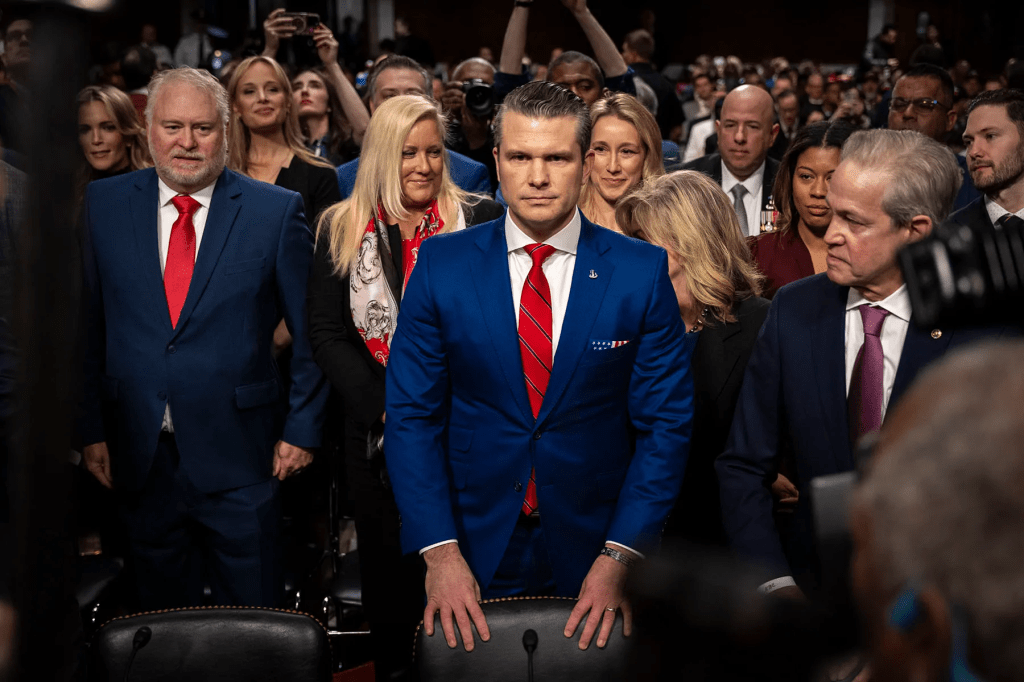
“I’m straight up just saying we should not have women in combat roles. It hasn’t made us more effective. Hasn’t made us more lethal. Has made fighting more complicated,” – Shawn Ryan podcast, Nov 7th, 2024
The following are excerpts from Hegseth’s book, The War on Warriors, chapter 5:
“The gender integration of the military is a huge part of our modern confusion about the goals of war. In particular, the choice to put women in combat roles.”
“Women bring life into the world. Their role in war is to make it a less deathly experience.”
“Our military now trains our metaphorical life givers to be combat life takers and then when they become biological life givers our DoD and VA help them be baby life takers in the name of keeping them on the team as combat life takers. The logic of evil.”
Hegseth believes that the integration of women into combat units has resulted in the altering/lowering of standards that make the United States military less effective and less lethal. What wasn’t 100% clear from the hearing is whether Hegseth believes that women should serve in combat units provided they meet the same standards as men. In other words, does Hegseth have a moral or philosophical position that would negate any opportunity for women to serve in such roles?
This is a question that Christian needs to answer from a biblical perspective, but doing so means that we understand the foundational principles. If we build our answer on shifting tectonic plates, we may find that our answer has become meaningless in a matter of a few years when the issues have shifted . So I would like to work our way through this issue by means of a fundamental question “What happens when the pursuit of egalitarianism is confronted by natural disparity?” along with a biblical answer, followed by a thought experiment and its biblical analysis, and concluded by a discussion on the integration of biblical principles with civil law. So…yeah, it’s a lot.
Now, why put all this effort into this question? First, there is simply the opportunistic timing provided by Hegseth’s nomination hearing. Secondly, there is the increase in interest among young women to go into the military and its advisability from a Christian perspective. And lastly, this issue allows us to draw general principles which apply to other issues, such as: women and men competing against each other in athletics, the prominence of women in LA’s fire department, and even the decreasing fertility rates we see in our nation.
Question – What happens when the pursuit of egalitarianism is confronted by natural disparity?
Egalitarianism is the word I am using to describe this impulse to push for a sort of universal, unqualified equality. America as a nation is more egalitarian by nature that most others. Not only are principles of equality enshrined in our founding documents, as in “We hold these truths to be self-evident, that all men are created equal, that they are endowed by their Creator with certain unalienable Rights, that among these are Life, Liberty and the pursuit of Happiness”, but they are bound up in our shared history and experience. These principles have not been universally manifested in our nation’s history, but they are demonstrably present as a matter of law and culture to a degree unknown in any other nation. My claim is not that America has achieved equality, but equality has always been pursued as a noble and desirable pursuit in our social imaginary.
The military, as an institution, has lended itself toward egalitarianism because of its focus on meritocracy. Promotions and commissions are not based on aristocracy, but on merit. The result has been a mingling of higher and lower social status persons into a unified body that created bonds strong enough to endure across traditional sociological boundaries, such as social status or ethnicity. This has been of particular benefit to those of lower social status (think low income, dysfunctional family, or immigrant family) as it allowed such individuals to attain an honorable social position, economic security, relationships beyond their own social strata, and opportunities in education and employment that otherwise would have been difficult to achieve. In this way, the military has been a positive influence for integrating “outsiders” into society and providing an opportunity to rise to higher social positions within that society.
Disparity, on the other hand, is the photonegative of equality. Disparity refers to a situation where things don’t equal out. Natural disparity refers to a situation where things are, by nature, not equal. In the case of women serving in the military, what happens when the pursuit of egalitarianism is confronted by the natural physical disparity between men and women? Just to prove that such really is the case, I went to the Army website and downloaded the ACFT (Fitness Requirements) (downloaded on 1/18-2025). Across every standard of measurement given, there are different scoring criteria for not only age groups, but men vs women. Without exception this is true for a perfect score, and almost without exception it is the case for the minimum requirements. This means that not only does the Army acknowledge that there are physical disparities between a 21 year old and 45 year old, but that there are physical disparities between men and women.
But if egalitarianism insists on the pursuit of equality between men and women, what do we do with these natural disparities? First, we have to decide what we mean by “equality”.
Equality of opportunity – Each individual may pursue his/her objective. They are judged according to the same standards as everyone else. They are not discriminated against in any way that others are not discriminated against. According to this definition of equality, women may pursue any position within the military provided they meet the same standards as everyone else (including men). According to this position, the Army’s current fitness test discriminates against men by requiring them to achieve a higher fitness standard than women.
Equality of outcome – Each institution should manifest an equitable percentage of sociological identity groups, the number and nature of which tend to be designated by the government as “minority” groups. In this case, equality means that the military, and more granularly its various departments and units, be composed of roughly the same number of women as men, since this is reflective of the general population. Should there not be enough women interested in the military to achieve this, funds will be invested to target and recruit more women into the military to remove the disparity. Or in the case where women could not meet a physical standards, those standards could be re-evaluated or more investments could be made to increase the likelihood of women achieving that standard.
Equality of value/worth – Each individual has an equal intrinsic value as a human being, and as such will retain a base-line of rights afforded in the constitution. This concept does not speak to women serving in the military or to any other specific pursuit, but is a general understanding of the nature of individual value.
Equality of function – Each individual, regardless of biology, sociology, education, or competency may pursue any office or function that they desire in society. In this view, women would be allowed to serve in combat roles regardless of whether or not they could meet the standards.
Out of those four definitions, which did the founders intend? Which do the advocates of absolute egalitarianism intend? To which would the average American high schooler subscribe? From a biblical perspective, Christians should only feel obligated to defend option #3 – that every individual has an intrinsic value. In fact, outside of Christianity, there is no coherent philosophical justification for this contention, because if society determines value (as is happening in the case of the unborn, where large portions of society do not want to grant the value associated to “personhood” to unborn children), then society becomes the arbiter of individual value and hence, there is nothing intrinsic about it. But Christians believe in the imago dei, which is a coherent, philosophical justification for ascribing a high and equal value across ethnicity, sex, age, or ability.
Gen 1:27 So God created man in his own image, in the image of God created he him; male and female created he them.
However, the other 3 definitions of equality are not Christian in nature, often contradict a coherent Christian theology, and have no claim over Christian behavior. Christians are not obligated to pursue an equality of outcome or an equality of opportunity or an equality of function, because each one of these will at times contradict the reality of natural disparities that exist in our world, and which are features, not bugs, of living in a diverse universe created by God to be such. There is no “inalienable right” to unfettered access to any arena of life which ones wishes to pursue, nor is such desirable, nor is it advisable.
1Co_4:7 For who maketh thee to differ from another? and what hast thou that thou didst not receive? now if thou didst receive it, why dost thou glory, as if thou hadst not received it?
1Co 12:5 And there are differences of administrations, but the same Lord.
It seems to me that there are two possible answers to our question, “What happens when the pursuit of egalitarianism is confronted with natural disparity?” The first option is to accept that egalitarianism may be desirable in certain circumstances, but it should not be the sole or highest goal for society. In other words, we should abandon the egalitarian ideal as an unqualified universal good, particularly when using definitions of equality that include equality of outcomes, but even at times acknowledging that equality of opportunity is not universally necessary or desirable for the happiness of the individual or the health of a society.
The second option is to functionally deny the reality of natural disparity. This can be done by turning the natural into the unnatural via technological innovation (for example, the attempt to turn men into women or vice versa via surgery or artificial hormones) or by simply adjusting the standards in such a way that they compensate for natural disparity. In other words, move the disparity from the outcome side to the opportunity side in such a way that the outcome becomes more uniform. The result of this is the lowering of standards, at least for certain people. An example of this would be a university requiring lower test scores for minority students than for white students, or the marines requiring men to run farther or faster than women.
The Christian answer to the question, “What happens when egalitarianism is confronted by natural disparity?” is that egalitarianism should be abandoned and natural disparity be acknowledged in the specifics of the situation. There are natural (God-given, God-ordained, and God-approved) disparities in the world, the most basic of which is the distinction between man and woman (male and female). This disparity should be factored in when considering the advisability of including women in combat roles.
Gen 1:27 So God created man in his own image, in the image of God created he him; male and female created he them.
Hegseth’s position reflects an acknowledgement of the natural disparity between men and women. He believes that the demand for an egalitarian military – particularly the inclusion of women in combat roles – has resulted in the lowering of standards, which has compromised the effectiveness and lethality of the military. This position does not actually require one to be a Christian (although Hegseth does identify as a Christian), because its validity may be proved from an observation of nature apart from Christian writings or dogma. We could imagine a very non-religious Army Ranger holding this view from what could be termed practical observations. But is a natural physical disparity the only consideration regarding this issue? Stay tuned for Part 2.

 Nathan Writes
One thought on “Women in Combat”