(This is the transcript for a “talk” given during teacher training at Gloria Deo Academy)
Introduction
In an opinion piece by New York Magazine senior writer Sarah Jones, she opines on the democratic campaign to make JD Vance, Donald Trump’s running mate, seem weird. She writes, “Conservatives have long staked out a claim to be the movement of traditional values, of families, of normal people, all in contrast to liberalism. The weirdness attack works so well because it flips that script and fights on important cultural terrain. It’s weird to care about how many children people have. It’s weird to treat women like incubators. It’s weird to care about people being drag queens. It’s weird to (expletive deleted) because some people are trans. It’s weird to obsess over alleged sex differences. Most people aren’t like this and don’t want to be like this, either.
The democratic party’s decision to paint JD Vance as “weird” is somewhat of a bet that the majority of Americans consider what would once have been a “normal” perspective on children, marriage, the differences between men and women, etc… to now be weird. This is a worldview question, and we are in a battle of worldviews.

In 1947, Dorothy Sayers delivered a lecture at Oxford University entitled “The Lost Tools of Learning”, in which she advocated for a return to the classical model of education summarized in the Trivium (or the 3 phases of learning) – Grammar, Logic, and Rhetoric. 44 years later, pastor and author Douglas Wilson published a book entitled “Recovering the Lost Tools of Learning” which, to a significant degree, launched the modern classical Christian education movement. While all of this is very interesting to those in the field of classical education, which you are or are about to be, it also matters to the subject with which we are dealing today: the Biblical Worldview.
From a biblical perspective, how do we justify or define or explain the importance of a biblical world view? In other words, is the very concept of “worldview” a legitimate biblical category or is it something that we have co-opted from philosophy or academia? I believe it is a legitimate biblical category, so let us go to the pages of Scripture and then return to Dorothy Sayers for some interpretation.
Gen 1:26-27 And God said, Let us make man in our image, after our likeness: and let them have dominion over the fish of the sea, and over the fowl of the air, and over the cattle, and over all the earth, and over every creeping thing that creepeth upon the earth. (27) So God created man in his own image, in the image of God created he him; male and female created he them.
In The Mind of the Maker, Dorothy Sayers attempts to answer that mysterious question, “What does it mean to be made in the image of God”. And the answer she gives is that the one thing we know about God in Genesis is that God is a Maker, and therefore to be made in His image means that we are all makers.
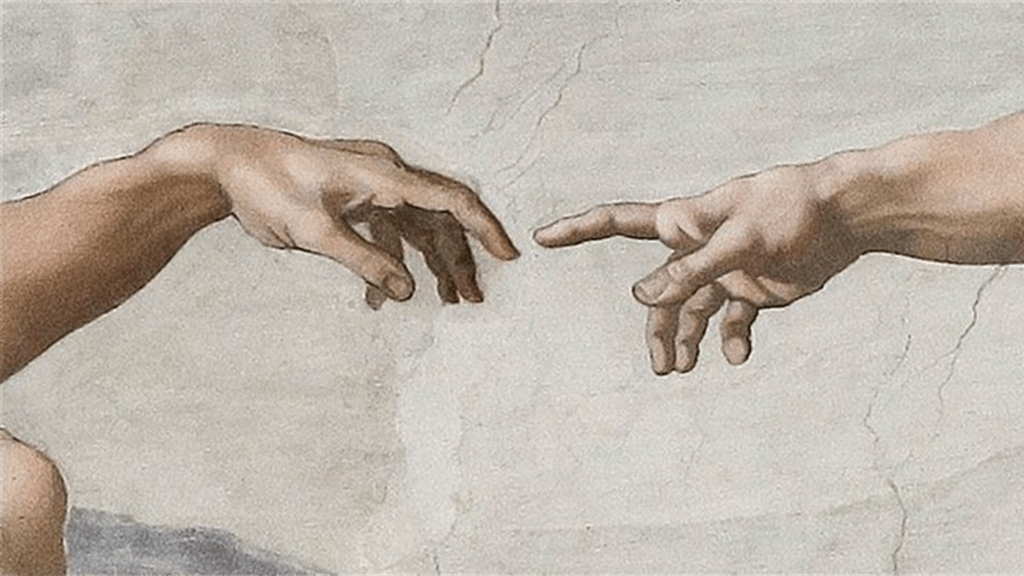
This curious fact about humanity is born out by experience. While some animals create out of necessity, like the birds who construct their perennial dwellings, mankind makes not only for necessity, but also for pleasure, for beauty, for curiosity, and for comfort. So those of you teaching in the lower grades will find that your students derive great benefit and pleasure from learning through crayons and scissors and glue, and those of you in the upper grades will find that your students create through lyrics, brush strokes, and melody.
But there is another kind of making that requires no such apparatus. It does not even require working hands or nimble fingers. Far before the first art work gets pinned on the fridge, your tiny tots are already making with their minds. They are meaning-makers, and they can’t help it.
Let me repeat that: all human beings are meaning makers. The knowledge that we possess never exists in isolation of other knowledge that we possess. Our minds create meaning. We link one thought to another until they make sense to us, even if the sense that they make is nonsense. So it is perfectly possible to make illogical, non-sensical, and incoherent meaning, just as much as it is possible to make a boat that is destined to sink or a building that is destined to fall or a meal that is destined to taste bad. We are meaning makers, but we are not flawless meaning makers, and we are certainly fallen meaning makers.
The fact that all people are meaning makers is the foundational truth and the creational reality that requires us to utilize the term “world view”. Because our students are meaning makers by design, they will assemble the truth that they have learned into some sort of working model by which they interpret the world around them.
A worldview, then, is one’s fundamental beliefs about the nature of reality that influence and shape one’s attitude towards everything else. Like the glasses that I put on every morning through which I perceive the world around me, my world view consists of the examined or un-examined, assumed or proven, acknowledged or unacknowledged beliefs through which I interpret the world around me.
The toddler’s world-view has himself at the center with the purpose of all other humans being to make his life pleasurable. He interprets the actions of others through the interpretive grid of self-fulfillment, never stopping to consider whether mom may have a headache or dad may have particularly difficult project to complete at work or whether the presidential election is looming. All such information is subjugated to the overarching narrative in which the toddler is the center.
A biblical worldview, or a Christian world-view, is one in which the foundational beliefs about life are consistent with the biblical narrative of God’s interaction with humanity via creation, fall, redemption, and consummation and its accompanying doctrines, such as the theology proper, Christology, etc…But human beings are more than a collection of thoughts: we are also have affections and desires which influence our interpretation of events and of others to conform to our own personal goals. So worldview consists not only of thoughts, but also of an internal hierarchy of desires and affections which color our interpretation of the knowledge that we possess.
In today’s talk, I would like to accomplish 2 things. First, I will give an abbreviated history of the Christian world view in the Western World so that we can understand the moment in which we find ourselves, and second and more practically for you folks, we will work through the relationship of the trivium to the development of a biblical world view.
A Brief History of the World
My father spent his formative childhood years in Franklin, IN, a town just south of Indianapolis. He remembers buying his first rifle at the age of 12 and walking through town with his buddies, guns on their shoulders, to shoot squirrels at the outskirts of town. In 1984 my parents left the United States to be missionaries in Japan and they returned in 2010 to a nation that my father no longer recognized.
The societal shift that happened in the thirty years of his absence was more than just a list of statistics concerning such things as crime, divorce, and psychological disorders. Those types of things were just the manifestations of tectonic shifts within the culture. What had happened? Here is my attempt to answer that question.
As a purely amateur historian, I freely admit that what I am about to describe is in the roughest terms. I am not an expert. So while some of the details may be debatable, I think the outline is correct.
The world that Christ was born into was, apart from the Jewish people, a pagan world. Through death and resurrection, suffering and martyrdom, divine Providence and human persistence, Christianity slowly conquered what we now refer to as “the West”. Swinburne, that modern pagan, wrote Hymn to Prosperine (an ancient Roman goddess), which is prefaced by the supposed last words of Emperor Julian, who tried to reverse the official endorsement of Christianity by the Roman Empire. Those last words are Vicisti, Galilaee (Thou has conquered, O Galilean). Swinburne’s poem laments the rise of Christianity and the death of paganism, stating at one point:
Thou hast conquered, O pale Galilean; the world has grown grey from thy breath
Swinburne was morally wrong, but technically correct. The world had grown pale, but not because it was diminished. The reality is that before our Lord and Savior was born, the world was in darkness. The world was growing grey with the breath of that pale Galilean, but it was the grey light of dawn, and the Galilean’s breath was the fresh air of resurrection on a Sunday morning in a garden tomb as the pallor of death gave way to the vitality of everlasting life. The old world, with its cruelty and hopelessness and debauchery, was passing away, and the Day Star was rising.
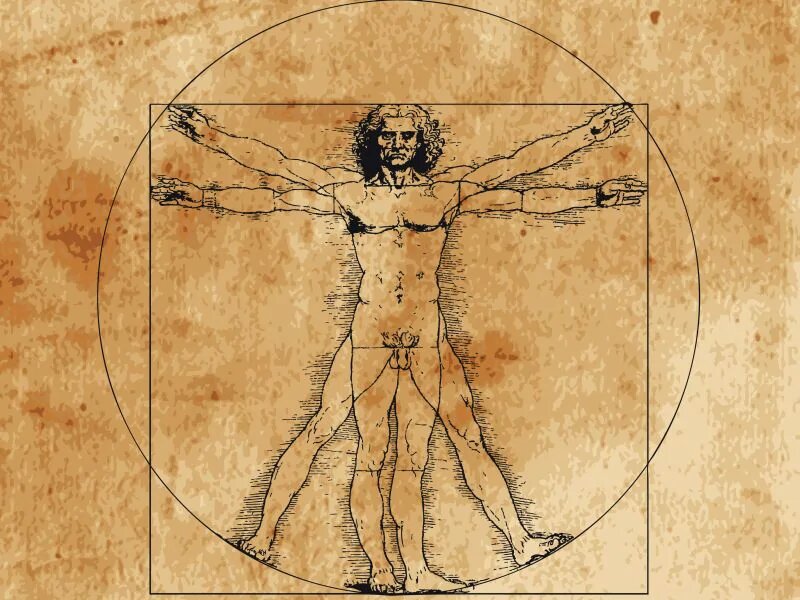
The Middle Ages represented roughly a millennium of Christendom, from AD 500 to AD 1500. During this period, we could say that Christianity ruled the West. In approximately 1487, as the stability of the Middle Ages was about to be shattered in the religious realm by the Reformation and in the Arts by the Renaissance and in the sciences by the Enlightenment, Leonardo Davinci gave us the Vitruvian man.
The Vitruvian man is a drawing of a man in two superimposed positions circumscribed in a circle and a square. The Vitruvian man represent a man perfectly balanced and proportioned. We could say that while the modern age is enviable for our living conditions, our technological prowess, and our medical knowledge, the Middle Ages was enviable because man was a balanced creature, both internally as a self-conscious being, and externally in relation to the world around him. The man of the Middle Ages might not know where his next meal would come from or whether or not he would survive a fever, but he knew who had created him, why he was here, and where he was going.
Fast forward 500 years and we are dealing with a social epidemic of teenagers who think that their internal sexual orientation doesn’t match their biological sex, or to put it more simply, kids who don’t know if they are a boy or a girl. What happened?
The unity of the human soul has been divided, chipped away, and shattered by a crescendo of worldly philosophies. The foundational truth statements that were taken for granted in the Middle Ages has been disparaged, doubted, ridiculed, contradicted, and generally undermined in every way conceivable.
To return to the illustration of my father’s return from living overseas, we could say that the accelerated pace of change he observed in a thirty year period was actually the result of many factors dating back hundreds of years. I think the West is less like that abandoned house in your neighborhood that has been slowly deteriorating for all to see, and more like a house that looks relatively strong, but its foundations have been slowly cracking and eroding until one day, it simply collapses.
Let me give you a modern day example of this. In 2004, then presidential candidate Barack Obama advocated for civil unions for homosexuals, but insisted that marriage was not a basic civil right. In retrospect, of course, we recognize that this statement may not have reflected any commitment to the principle of marriage, but was a political statement made with the calculation that the general American populace was not ready for “gay marriage”.
In May of 2012, then vice president Biden shocked everyone by stating on a Meet the Press interview, “I am absolutely comfortable with the fact that men marrying men, women marrying women, and heterosexual men and women marrying another are entitled to the same exact rights, all the civil rights, all the civil liberties…Who do you love? And will you be loyal to the person you love? And that’s what people are finding out is what all marriages, at their root, are about, whether they’re marriages of lesbians or gay men or heterosexuals.”
In less than a decade, the pro-gay marriage position went from politically untenable to politically advantageous. On the outside, this looked like a sudden and catastrophic collapse of the house of traditional marriage. But in reality, we could construct a timeline of events that undermined the concept of traditional (or natural) marriage for decades, if not centuries. Before such a position could become acceptable, the fundamental thinking on marriage had to shift. Let me read again vice-President Biden’s fundamental understanding of marriage:
“Who do you love? And will you be loyal to the person you love? And that’s what people are finding out is what all marriages, at their root, are about, whether they’re marriages of lesbians or gay men or heterosexuals” Such a statement could not make sense to someone living in 1850, or 1950, or even 2004. The dominoes had to be assembled in such a way that the fundamental understanding of marriage changed.
Consider the traditional wedding homily in the Anglican Book of Common Prayer, which gives the following purposes of marriage:
First, It was ordained for the procreation of children, to be brought up in the fear and nurture of the Lord, and to the praise of his holy Name.
Secondly, It was ordained for a remedy against sin, and to avoid fornication; that such persons as have not the gift of continency might marry, and keep themselves undefiled members of Christ’s body.
Thirdly, It was ordained for the mutual society, help, and comfort, that the one ought to have of the other, both in prosperity and adversity.
Vice-president Biden reduced marriage to one idea: love. “Love is love” is the motto we hear thrown around. Gone from the definition of marriage is the notion of child-bearing, because homosexuality is barren by nature. Gone is the notion of sexual purity, the very idea which is anathema to our sexually liberated society. Gone is the idea of complementarianism between male and female, which is implicit in the concept of “mutual society”.
Long before such a statement as was given by the vice-President could be well received by the culture, a biblical worldview had to be subverted and supplanted. The foundation of natural marriage had to be eroded, one chunk at a time, until the structure could collapse. Children had to become optional. Sexual expression of any kind had to become socially acceptable. The mutuality of male/female had to become the mutuality of any pairing of human individuals.

Consider this statistic from the Pew Research Center, which indicates that among those who identify as Christians, roughly half support or strongly support homosexual marriage while roughly half oppose or strongly oppose and a minority position are undecided.
How can half of Christendom be so divided on a topic concerning which Scripture, society, and church tradition have agreed for almost 2 millennia? The answer is that these two groups of people, though both identifying as Christian, have different worldviews that shape and determine their opinions on this topic.
What would that graph have looked like in 1995? Maybe a better question is: What will that graph look like in 2045, a mere two decades from now? Which side of this will your kids be on? Will they be in the majority or minority? If in the minority, will they have the commitment and courage to espouse a biblical worldview on this topic?
All right, so what has happened in the last 500 years or so that has brought us to this place? The Vitruvian man, that perfectly proportioned and balanced individual, has been torn apart. The unity of his being has been shattered. It happened one chunk at a time. David Hume separated the inner man from the outer man. Rousseau separated man from the fruits of his labors, while Marx would later come and, ironically, separate all men from each other. Darwin made it plausible for man to be a random creature in a random universe in which given enough time, something could come from nothing and turn into everything. All of these statements are terrible over-simplifications, and yet here we are, living in a world in which the same person who thinks that nothing exists outside of what can me measured in a microscope also believes that there are 21 genders.
There are a couple of authors that I would recommend to you. One is Carl Trueman, whose recent work “The Rise and Triumph of the Modern Self” is unparalleled in its scholarly telling of the philosophies that led us to this moment in time. Another author that tackled these subjects in the 20th century was Francis Schaeffer, who influenced others like Nancy Pearcey, author of books like Saving Leonardo and Finding Truth, among many other best sellers.
So without taking up an obscene amount of time, what we can say is that the foundational truths required for a biblical worldview have been eroding for centuries and what appears to be the sudden collapse of a house has actually been coming for a long time.

The Recovery of A Biblical Worldview
Psa 11:3 If the foundations be destroyed, what can the righteous do?
The psalmist was well aware that no edifice can endure if the foundation is destroyed. As well meaning as the righteous might be, without a foundation we are destined for collapse. What the West needs is a recovery, or a restoration, of the foundation that we once had. How is this to be done? Through Christian education. Of course when I say that, I am not confining Christian education to the school. The educating of children is the responsibly of parents. But parents need tools, and Gloria Deo Academy is a tool that they can use to accomplish their God-given responsibility to raise their children in the nurture and admonition of the Lord.
It is hard to overstate the importance that education has played in the slow collapse of the west. From Darwinism to Marxism to sexual liberation, the ideas have been introduced by the scholarly class and disseminated through institutions of learning.
We must do more than raise children who can recite Bible stories or even Bible verses. We must raise children who understand the underlying narrative of all of life. They have to know the story to know where they fit into the story.
I have purposely used the word story because I want to make sure we don’t fall into an error. Sometimes, when we are engaged in a task like this, we fall into the trap of over-simplification. One way we do this is by putting everyone into a categorical box and saying things like, “Well, she just thinks like that because she’s a post-modernist.” This type of categorization is actually a way we violate a biblical worldview, in which individuals are much more than the philosophy which they currently espouse. Human beings are made in the image of God. Knowing, understanding, and loving people involves more than categorizing by philosophy. God reveals Himself to us not only through truth statements, but by covenant, judgment and redemption in the narrative of progressive revelation. Truth is greater (but not less) than truth Statements, and ultimately finds its essence not in a philosophy, but in the Person of Jesus Christ.
For our children to know truth, they must know Jesus. They must walk with Jesus and discover that their story isn’t about them, but about Him. History is “His Story”.
So what is your task and how does it relate to this idea of developing a biblical worldview? Gloria Deo Academy is a classical Christian school, and that means that you are not only teaching children what to think, but how to think. Specifically, you are unapologetically teaching kids how to think like Christians.
Grammar
At this stage of education. Which typically takes place in what we would call elementary school, you are teaching kids facts. You are giving them blocks to build with. Young children can absorb and memorize lots of information, so you are teaching them through songs and poems and activities. And the wonderful thing about Christian education is that we are not afraid to teach our children truth. There is no true truth that threatens God. Have you every considered that God could have written a much different book? One that hid that terrible failures and atrocities committed by His people? He could have written a book where the Father of the Faithful’s cowardice and lies were not revealed. He could have written a book where envy didn’t drive the patriarchs to sell their brother as a slave. But God is not threatened by truth.
This stage of learning is so important to a biblical worldview because you are giving kids the basic blocks they need to construct that biblical worldview. Consider what is being taught by government run education. The 1609 project, in which slavery is the foundational principle of the founding of the USA. That’s basic revisionist history. Or consider the different edifice that they will construct if one of the foundational building blocks they are given is the idea that mankind is the result of blind process. To be taught that you are made by a Creator in His image is a whole different thing than to be taught that you are a more advanced version of an ape.
So the grammar stage is where you give your students the knowledge the will later use to construct their worldview.
Logic
This is the stage of learning where kids began to ask questions and make connections between facts. This is where the “how to think” lessons begin in earnest, because your students are meaning makers. Have you ever wondered why classical Christian education incorporates lessons on logic and logical fallacies? It is because without the ability to assemble knowledge into a coherent system, students will assemble knowledge into an incoherent system. I say again, we are all meaning makers, but it doesn’t necessarily follow that the meaning we make MAKES SENSE.
If we can return to the basic building blocks and contrast the kind of logic that will flow from those who believe that we are made in the image of God vs those who believe that we are cosmic accidents, we can see where the basic foundational errors turn into systemic errors. For example, accepting the Darwinian view, we have to admit that mankind is not what it was. We used to be something different (apes or birds or primordial goo), and this means that in the future we may become something quite different. So the logic of the evolutionist argues against fixed categories for things. It argues against the concept that things have a nature that is relatively fixed. Nothing is fixed, given enough time.
The creationist, on the other hand, believes that things were made relatively as they are and thus, mankind has a fixed nature. His ancestors were essentially the same thing he is and his descendants will be essentially the same also. The logic of creationism and the logic of evolution create two vastly different systems on multiple levels.
Rhetoric
I love the final stage of the trivium: rhetoric. I joke that we spend a lot of time teaching our little toddlers to talk and then we spend the rest of their lives trying to get them to shut up and listen. But we want kids who can engage. Many kids from Christian homes go off to secular university and emerge as agnostics or atheists. If we aren’t building students who can engage with the culture around us without falling apart, then we are going to continue to lose kids to the world.
I have been a creationist all my life. When I was in high school I took a dual credit course science course through Indiana University in which one of the assignments was to explain how plastic eating worms evidenced the evolutionary process. That was over twenty years ago, and the world has only doubled down on the dogma of Darwin. We recognize that the world is less friendly to Christians, in many ways, than it was twenty years ago, which is why we prepare our students with better answers.
Conclusion
We are told that we are living in a post-Christian world, but I think that is the wrong perspective. I believe that we are living in a pre-Christian world, because the future is Christian. Our ancestors conquered the West once before, and they did it without money or power. Our children can do it again. And that means that we have to teach them how to be Christians. We have to disciple them. We have to make them our first target of the fulfillment of the Great Commission. To that end, we need to teach them the grammar of the Christian worldview, the logic of the Christian worldview, and the rhetoric of the Christian worldview.
The fundamental fact of the Christian worldview is that Christ rose from the dead.
The fundamental logic of the Christian world is that the transcendent Christ is the One in whom all things consist (make sense)
And the fundamental rhetoric of the Christian worldview is that Christ is Lord.

 Nathan Writes