When a group of families sued the Classical Christian school that my kids attend, I wrote a rather long post with the goal, not of affirming or denying the charges, but of providing some biblical categories for pursuing justice. Since that time several things have taken place:
1) several families removed their students from enrollment, including the litigants. This resulted in
2) the withdrawal of the lawsuit, as the families no longer had any standing to bring suit against the school
3) two letters/emails that were publicly shared to the school community by two separate litigants, which either asserted rebuttals to the school’s public statements, or additional accusations. While these were signed and made publicly available (I have not linked to them because my post is available to the public and I do not have their consent), and
4) two letters written by the head of school and the administrators/principals respectively, which I think was an attempt to bring closure and move the school forward.
My response will be a little bit harder to organize than my previous post, but my goal continues to be to help Christians think biblically and wisely through a tough situation. From one perspective, the school has fared very well through this as none of the apocalyptic events have materialized. Specifically, the school has not lost its accreditation and continues to operate. The dismissal of the lawsuit makes a hat trick. But the parting communications from the litigants has been a cause for distress for many, which is why I think it is worth addressing.
The Chaos of Conflict
As conflict escalates, confusion increases. It is the fog of war. Interestingly, this confusion affects all sides, even the aggressors. For example, one former litigant refutes that her actions were associated with the “poison pen” email that had been part of the original Brouhaha. But just as the defendant doesn’t get the privilege of differentiating between every kind of accusation in the minds of the observers, so the aggressor doesn’t get to demand that the defendant check the return address on every bomb that lands in its territory. The litigation and the poison pen email were part of a series of accusations against the school, both events fed off each other in terms of causing confusion among the parents, and thus the difference becomes indistinguishable. For the defendant, it matters little whether its attackers are cobelligerents or allies, however the aggressors might want to make that distinction. This is the cost of war.
But for those of us who are, let’s call us involved observers, there are distinctions worth noting. For example, what if the the complaints turn out to be true but the more serious accusation are false? What if there is a genuine problem in communication, or management, or planning, but it is not a moral failing but a failure of competency? From my perspective, the seemingly endless numbers of complaints/accusations -that range in seriousness from the illegal to the silly- muddies the distinctions that might prove in the end to be an opportunity for improvement. When it becomes laboriously difficult to differentiate between unsubstantiated gossip and potentially legitimate critiques, the likelihood of a God-honoring resolution seems to recede from view. We need more light and less heat.
The scope of the chaos is related to the methods used: the less godly the methods, the more the conflict. Lies, gossip, slander, and malice = greater chaos. Staying in your lane (Ecclesiastes 7:16), keeping the conflict small (Matthew 18:15), and addressing one’s own heart first (Matthew 7:3) = less chaos.
The Collateral Damage of Conflict
As conflict conflagerates (it must have been the letter C week for my kindergartener!), people start to get hurt. “I’m not trying to hurt anyone” and “I’m sorry anyone got hurt” are meaningless statements. One could easily imagine a remorseless politician saying such things. When objects collide, there is bruising. Conflict is always painful, and as it escalates it draws in more people who begin to careen off each other like billiard balls after a good break. But because we are people and not billiard balls, each one of these collisions is uncomfortable at best. Levels of discomfort may range from families who feel vaguely disappointed or betrayed, to individuals who feel personally attacked and wounded. Defensiveness sets in. A brother offended is harder to be won than a strong city, and their contentions are like the bars of a castle. The best advice I can give is to try to be un-offendable, to pursue truth, and to not let emotions exceed your sanctification.
Calumny
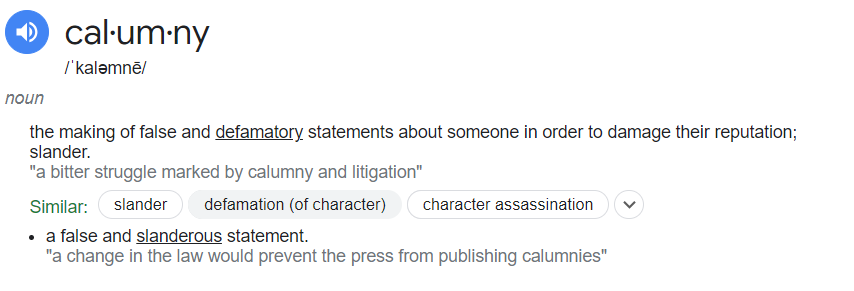
At this point, it is reasonable to say that there were many false (or at minimum confused) allegations made against various people and the school. For example, the allegation that the school would not have enough funds to even open in January was a false allegation. The charge that the school’s accreditation had lapsed or was in danger was a false allegation. This isn’t to say that every allegation is false, but it should serve as a caution to those making the allegations and those believing the allegations. To falsely accuse someone is a big deal, and it turns out that at least some of the accusations have been false, and no amount of “we have prayed about this” or “the Lord directed us” justify false accusations.
I would like to tread as cautiously and charitably as I can in this paragraph while avoiding shadow-boxing. In one of the parting emails, the following was stated “Disgusting sin is being committed, using our Lord’s name. The Board knows it. Joy knows it. The principals and staff all know it but don’t want to admit that they allow it.” (underlined for emphasis). This accusation, whether born out of emotional distress or frustration, is slanderous and needs to be withdrawn. I am not omniscient, and so I cannot categorically deny this charge on behalf of every individual at our school. But my eyes are in my head, and I can, with whatever certainty a man is capable of having before God, refute the claim that my campus administrator and the three classroom teachers my children are entrusted to are operating from a place of spiritual darkness.
While I only have students at one campus, I know that campus is a place where my kids are safe, where they are being educated, and where a genuine effort is made to teach and model Christ-like behavior. And just for good measure, my wife is on staff there and I think rather highly of her. It isn’t as though I am claiming that the school is a perfect place, but the people that I interact with on a regular basis, from parents to teachers to administrators, are normal Christians (in the best sense of the term) trying to walk in a way that is pleasing to God by partnering together for Christian education.
Additionally, the charge that there are those who “idolize Joy” is a very specific and serious charge, and I am confused as to whom it would apply. I haven’t met anyone at the school who idolizes Joy. I think this is simply a misunderstanding of why people haven’t accepted the allegations at face value and are unwilling to sacrifice Joy as appeasement to a group of angry parents. Idolatry is a big deal, and people certainly can be, and often are, idolatrous. But my honest evaluation is not that Joy is idolized, but that the accusations have not merited a response like the litigant desires, due both to the fact that there has not been enough compelling evidence and due to the means by which this war has been fought.
Having spent all of my life around Christian ministry, I have seen the idolatry of individuals, but more frequent has been the idolatry of institutions. This type of thing deserves its own post, or maybe even its own book.
Just as it would be wrong for me to think that every family that has withdrawn their students has malicious intentions, it is also wrong to broadly ascribe evil intentions to the administrators and staff. This is a two way street, and in this matter the accuser really does need to repent. If perfidy exists, it is not widespread.
Some allegations have been made that I am not in any sort of position to evaluate. For example, I have no access to the board meetings, I am not privy to the use of school funds, and I am ignorant of complaints made by staff. Apart from the fact that the school continues to operate, construction projects continue to be completed, and staff continues to be paid, I cannot begin to speak to the financial health of the school. I would only advise those making allegations be much more cautious, and to publicly apologize for allegations they have made that turned out to be false.
Cover-ups and Privacy
I would also like to once again point out that there is a difference between covering something up and being appropriately confidential. As an organization, the school has the right to make decisions without explaining every detail of that decision to every individual who wants to know. An explanation for everything would be time-consuming and counter-productive, and gratifying those who want to be “in the know” about every decision would take place at the detriment of educating students. Every institution has to determine for itself the level of transparency it will have with its “share-holders” as well as the means of communicating that information. If shareholders are not satisfied, they will relocate their investment.
For an institution of learning, there are certain things that most definitely should NOT be shared. The letter used the phrase “Tell parents” or “Let parents know” regarding past student behavior that no one has a right to know. The school is not a church where we confess our faults one to another. The school is dealing with children and adolescents who will at times display sinful, immature, or inappropriate behavior and we should expect those situations to be dealt with confidentially. It would be incredibly inappropriate for the school to broadcast disciplinary matter regarding a student. Parents should expect the school to keep their children safe and to appropriately discipline immoral behavior, but any expectation that the staff is capable of preventing such behavior is as ill-founded as expecting that parents will prevent all instances of such behavior.
The Defense, and an Alliteration Fail
So yes, I have run out of headings that begin with the letter C, but nevertheless I press on. Yea, I even Continue. As I stated in the introduction, the school has many things to be grateful for the position it is in today. The follow-up emails sent by the Head of School and Administrators indicated a desire to stay “on mission”, which I think has been the unspoken aim since the Brouhaha started.
When attacked, defensiveness is warranted. But there are a couple kinds of defenses. There is the kind of defense where a kid being attacked curls up on the ground and covers his head while the mob kicks him, and there is the kind of defense that looks suspiciously like a left jab followed by a right hook to the body. Now that the lawsuit has been dismissed, there is an opportunity for the school to make a robust case for itself. There are families on the fence about next year. There are tired and confused faculty. And current students, who are going to grow up in a world antagonistic to the Faith, are watching.
I am a believer in Christian education, so I think the concept of our school is sound. I would like to see our particular institution learn, grow, and thrive. If my judgment that the majority of our school community really does just want to carry out the mission of Christian education is correct, wouldn’t it be nice if this were all behind us? But like the old song writer wrote, “The only way out is through”. The school needs to not only make a robust case for Classical Christian education in general, but for itself as a desirable partner for Christian parents. This is not a time for the fetal position.

 Nathan Writes
One thought on “The Brouhaha, Part II”